
Most medical websites do not fail because of how they look. They fail because of how they are built.
A site can be clean, modern, and professional, and still produce almost nothing in terms of traffic or patient inquiries. That disconnect is where most practices get stuck. On the surface, everything appears to be working. In reality, the site is not showing up when patients are actually searching.
The difference almost always comes down to backend SEO and the structure underneath the site.
Patients Do Not Search for Your Practice First
Patients do not begin by searching your practice name. They start with uncertainty.
They are trying to understand a symptom, evaluate treatment options, or figure out whether something requires care. Their searches reflect that. They are broader, more question-based, and often happen well before a provider is ever selected.
If your website only speaks in terms of services, you are showing up too late in that process. By the time someone searches directly for a provider, they are already close to making a decision. The opportunity is earlier, when they are still researching and trying to make sense of what they are experiencing.
A website that is built to meet patients at that stage will consistently outperform one that is not, even if both look equally professional.
Why Backend SEO Is What Actually Connects You to Search
Most practices think of SEO as content or keywords. That is only part of it.
Search engines are trying to understand what your site represents. They look at how pages are structured, how they relate to each other, and how clearly each service is defined. If that structure is unclear, your visibility will be limited no matter how much content you produce.
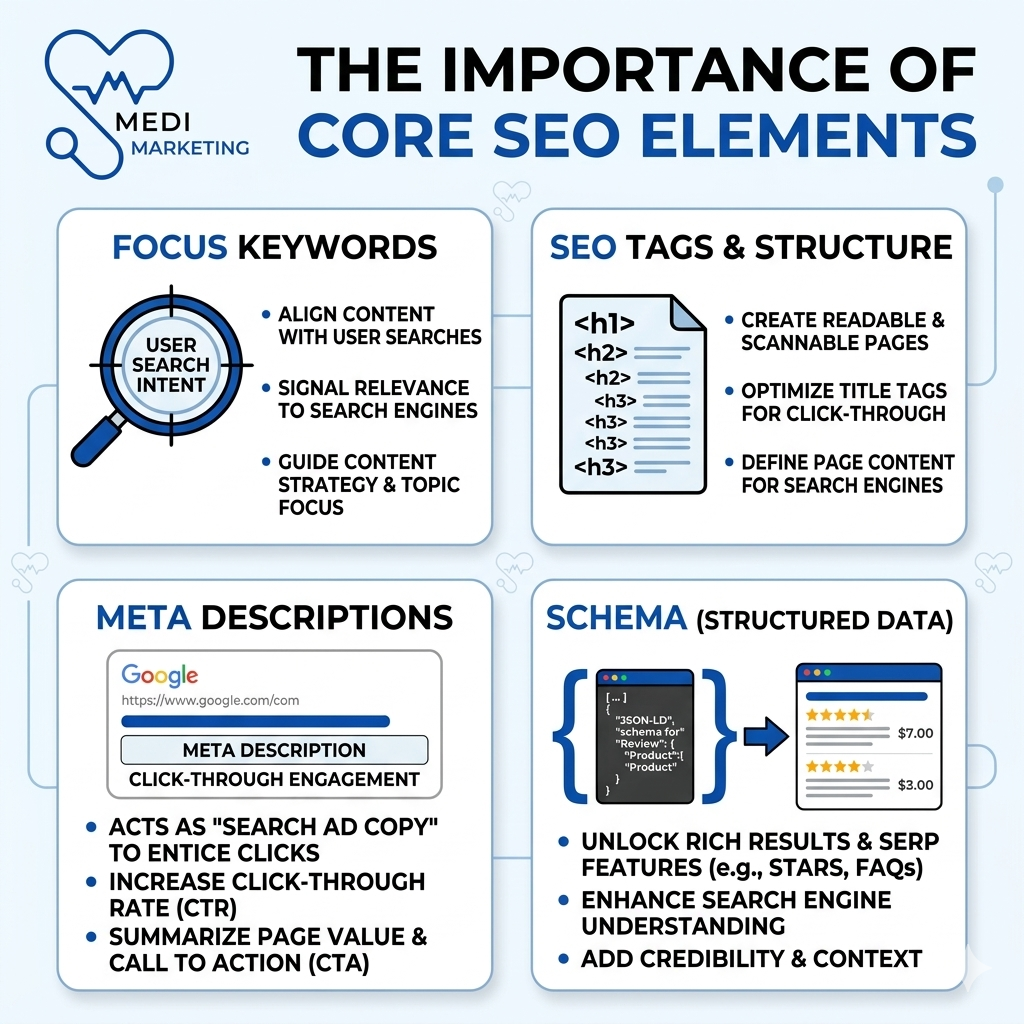
Backend SEO is what gives your website that clarity. It includes how your pages are organized, how headings are used, how internal links connect your content, and how metadata and schema define what each page represents.
When this is done correctly, search engines can confidently match your pages to the right searches. When it is not, your site becomes harder to interpret and easier to overlook. Visit our SEO Page to learn more about our process.
Structure Determines Whether Your Content Performs
Content alone does not drive results. Structure determines whether that content has a chance to perform.
A well-structured site creates clear pathways. A page focused on a specific service supports related content. Blog posts connect back to service pages. Internal links reinforce relationships between topics. Everything works together instead of existing in isolation.
Without that structure, even strong content struggles. Pages compete with each other, topics overlap, and search engines are left to guess which page should rank. That uncertainty leads to inconsistent visibility.
When the structure is right, the opposite happens. Pages support each other. Authority builds over time. And new content has a stronger foundation to perform from the start.
Technical Signals Shape How Search Engines Read Your Site
There are also technical elements that most practices never see, but they play a significant role in performance.
Things like title tags, meta descriptions, schema, and crawlability all influence how your site is interpreted. These are not visible to patients, but they shape how your pages appear in search results and how often they are shown.
A clear title helps search engines understand relevance. A well-written meta description improves click-through rate. Schema adds context and can enhance how your listing appears. Clean indexing ensures that only the right pages are being surfaced.
Individually, these seem small. Together, they create a much stronger signal.
Why Most Practices Feel Like SEO Does Not Work
When practices say they have tried SEO and did not see results, the issue is rarely effort. It is usually directed.
They may have added blog content, updated pages, or worked with a vendor, but the underlying structure of the site was never addressed. Without that foundation, the work does not connect.
SEO is not about doing more. It is about doing the right things in the right order.
When the structure is weak, everything feels inconsistent. When the structure is solid, results begin to build in a way that is more predictable and easier to scale.
What It Looks Like When the Foundation Is Right
When backend SEO is handled correctly, the website starts to behave differently.
Pages begin to rank for specific, relevant searches. Traffic becomes more consistent. The people arriving on the site are earlier in their decision process and more aligned with the services being offered.
Over time, this leads to more inquiries, more qualified patients, and less reliance on paid channels or third-party platforms.
The site stops being a static presence and becomes something that actively contributes to growth.
The Bottom Line
Most practices focus on what they can see. Design, branding, and surface-level updates get the attention.
What actually drives performance sits underneath that.
Backend SEO is what determines whether your website is understood, trusted, and surfaced when patients are looking. Without it, even a well-designed site will struggle. With it, everything else you do becomes more effective.
That is the difference between a website that exists and a website that consistently brings in new patients.