
A medical practice blog has a clear business purpose in 2026: getting your practice seen. It expands the searches your website can appear for and creates opportunities for your content to be referenced in AI generated answers. Whether someone becomes a regular reader is secondary. The first job is to put your practice in front of people searching for information connected to the care you provide.
At Medi Marketing, we see blogging as part of your search strategy. Each article should have a reason to exist: a relevant search opportunity, a connection to your services, and information worth finding. A busy practice needs to know how that work contributes to visibility. Publishing simply to keep the blog active is a poor use of the budget.
Service Pages Cannot Cover Every Relevant Search
Your service pages should establish what you offer, where you provide it, and how someone can schedule. They deserve attention before you invest heavily in articles. But even a strong service page has limits. A page about hearing evaluations cannot thoroughly address every question about hearing tests, results, appointment preparation, and follow up care without becoming difficult to navigate.
A blog gives those related topics room. An audiology practice can publish a focused article about what a hearing test measures and connect it to its evaluation page. That article can compete for an informational search while the service page addresses someone looking for an appointment. Both pages support the same area of care through different searches.
This is the practical value of SEO for medical practices. Your website gains coverage beyond the small set of terms associated with its main services. The opportunity comes from covering relevant topics well. Adding pages alone does not make a practice more visible.
AI Search Creates Another Place Your Practice Can Appear
Traditional search presents links that people can choose to visit. AI search may assemble an answer from several sources and include citations to supporting pages. Generative engine optimization, or GEO, describes work intended to improve visibility in those answers. For a medical practice, that can mean a linked article or a mention of the practice when it is relevant to the question.
The relationship between these results deserves attention. A peer reviewed study published at the 2026 ACM Web Science Conference examined 900 health related Google searches in the United States. AI Overviews appeared for 87.7 percent of the queries studied, with 46.2 percent source overlap between organic results and AI citations. Those figures describe the study’s sample, rather than every medical search.
The implication for practices is that traditional rankings tell only part of the visibility story. Appearing in ordinary results does not automatically mean appearing in an AI answer. A blog provides additional pages that may be discovered and referenced, although no article format guarantees selection. Both forms of visibility deserve consideration when planning content.
SEO and GEO Need a Shared Content Strategy
Practices should be cautious about treating GEO as a reason to abandon established SEO work. Google’s current guidance on generative AI search says its AI features rely on core search ranking and quality systems. It also says websites do not need special AI markup or tiny blocks of text to appear in those features.
That supports a practical approach: build content around relevant search demand, add information grounded in your practice’s expertise, and keep the website accessible to search systems. A blog should extend the substance already established by your service and provider pages. It should help your site explain the care you offer in greater depth.
A detailed explanation of your evaluation process gives you something more distinctive than a rewritten definition of a condition. The same applies to questions about treatment decisions or appointment preparation. Your clinicians’ explanations can provide substance that a general summary lacks. Medical claims still need appropriate review and support, regardless of whether the article’s commercial purpose is visibility.
Choose Topics That Support the Services You Want Found
A practice can attract substantial traffic from topics that have little connection to its business. That creates an impressive report without necessarily increasing visibility for the care it provides. Before approving an article, ask which service it supports and why someone making that search could reasonably need your practice.
For an ENT office, questions about sinus evaluations may be more useful than a broad article about staying healthy during winter. For a counseling practice, an explanation of individual therapy versus couples counseling may be more relevant than general productivity advice. Topic selection should follow the services you want discovered and the searches surrounding them.
We recommend evaluating each proposed article against four questions:
- Is there a relevant search opportunity? Use search data and existing website performance to assess the topic.
- Which service does it support? Identify the connection before drafting.
- What can the practice contribute? Include accurate explanations, professional perspective, or details about receiving care.
- How will we assess visibility? Decide which searches, page impressions, referrals, or AI citations matter.
This makes content marketing for medical practices more accountable. Each article has a defined role within the website. The publishing schedule follows worthwhile opportunities and the practice’s ability to review the work.
Structure and Internal Links Give the Content a Clear Role
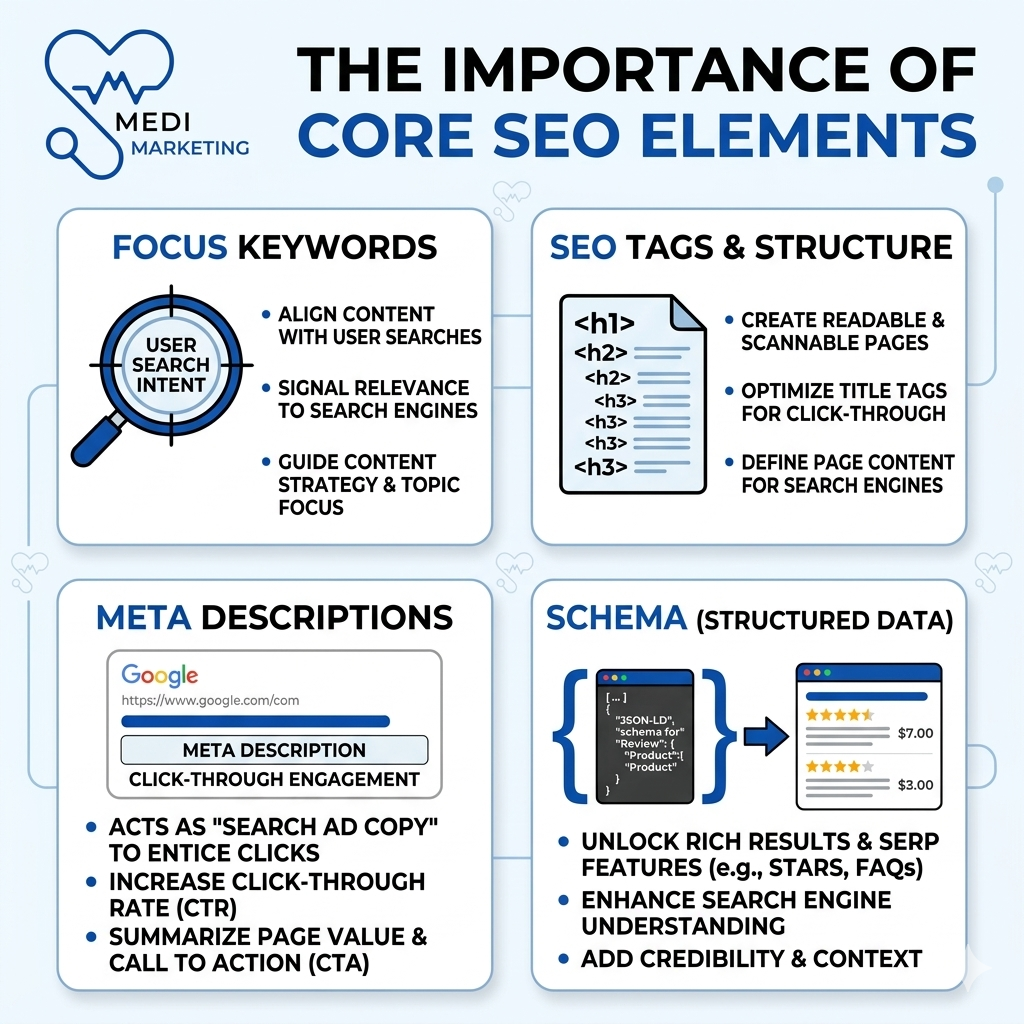
Use a descriptive title, one H1, and H2 headings that organize the subject. State the article’s central answer early, then develop it through complete paragraphs. Readers should be able to understand what each section contributes without navigating repetitive questions or filler. Writing for visibility still requires content that makes sense when someone lands on the page.
Internal links connect that article to the rest of your website. A post about hearing test results should link naturally to the hearing evaluation service page. A discussion of your assessment process may also warrant a link to a relevant provider. Descriptive link text helps readers understand the destination and makes the relationship between the pages clearer.
The website needs to support discovery as well. Check that articles are accessible, indexable, and connected through navigation or relevant pages. Reliable performance and readable layouts are part of medical website design. A publishing program loses value when its pages are difficult to find or use.
Measure Whether Your Practice Is Becoming More Visible
Start by reviewing which relevant searches produce impressions and visits, and which articles contribute to that exposure. Look beyond total traffic. Growth around a service you want found is more useful than growth driven by unrelated topics. Also check whether readers continue to service pages or return later through searches for your practice.
For GEO, monitor relevant AI mentions, linked citations, and identifiable referral visits. Results vary by platform and question, so occasional screenshots should not carry an entire performance claim. A citation can create exposure without a click, but it should not automatically be credited with an appointment.
A medical practice blog deserves investment when it expands relevant visibility. Build it around the care you provide, maintain the articles worth keeping, and measure whether your practice is appearing in more of the searches that matter. In 2026, that is the case for blogging: more opportunities for the right people to encounter your practice.
Learn More About Medical Marketing
- Practice Spotlight: Restore Counseling and How Medi Marketing Supports Mental Health Practices Around Richmond, Virginia
- SEO and GEO in 2026: A Practical Guide for Medical Practices and Healthcare Organizations
- Ranking Medical Marketing Models for Practice Growth | Medi Marketing
- The Definitive Guide to HIPAA-Compliant Marketing for Medical Practices
- Practice Spotlight: Ascend Health & Wellness in Mooresville, NC